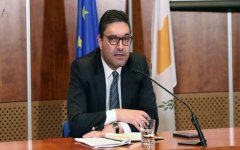
[/QUOTE]Statement by Minister of Finance, Constantinos Petridis Response to AKEL and criticisms on energy issues Taxation of excess profits of Renewable Energy Sources
"As a main election and economic manifesto", he describes the "daily accusations" of AKEL,, as Finance Minister Konstantinos Petrides called them, referring to energy issues.
- New AKEL 'attack' on Government: 'We are paying for their failure on energy issues with very expensive electricity'[/URL][/B]
- AKEL is now taking on Pilidou. "Where does the Energy Minister live?"
"AKEL has been raising daily, as its main election and economic manifesto, the taxation of "excess profits" of energy production companies through Renewable Energy Sources (RES)," it says.
On the above, the Minister notes that despite the fact that "to date I have avoided any confrontation despite the daily accusations, I would like to note the following":[/B]
- The promotion of investment in RES is the most important pillar of the green transition and an important priority for the Government. We seek to support and further develop the sector, which is in its initial stages in Cyprus. An attractive and stable legislative and fiscal framework for the penetration of such investments is a basic prerequisite.
- The two proposals for a law by AKEL, on taxation of excess profits of companies supplying electricity from RES, and the imposition of a counterpart fee on bilateral RES electricity contracts in an amount exceeding the maximum purchase price from RES determined by a decision of RAEK, are sketchy. Without economic rationale and undoubtedly, they act as a disincentive in a punitive manner against such investments and will act as a disincentive to the prospects of encouraging and developing the sector. A sector that is the solution to cheaper energy is seen by AKEL as part of the problem.
- In particular, the 1st legislative proposal is based on the difference in gross profit margin compared to the previous year, and does not take into account the total costs as it is based on costs related to cost of sales only. Further, and under the provisions of that Proposal, the taxation is imposed only on RES suppliers and excludes RES producers participating in Projects until the start of the Competitive Electricity Market, which minimizes any revenues generated by such taxation. Under the provisions of the 2nd Proposed Law, the retaliation fee to be imposed on future RES electricity sales does not take into account any excess profits generated since the onset of the energy crisis due to Russia's invasion of Ukraine, and also disregards the overall costs of the party selling RES electricity.
- Taxing excess profits of RES suppliers and imposing a countervailing charge on bilateral RES electricity contracts under the provisions of the AKEL proposals will result in very limited revenues. It is a challenge to the intelligence of each of our fellow citizens to present these potential revenues as the solution for redistributing wealth for the benefit of our fellow citizens due to the energy crisis. At a time when the Government has so far allocated more than €400 million through the electricity price subsidy, the reduction of excise duty on fuel, a reduction in VAT on electricity, an increase in the heating allowance in mountainous areas, and other targeted measures in agriculture and other vulnerable groups. And while including over €150 million in the budget to subsidise energy efficiency measures and photovoltaic systems in households and businesses. In other words, to date the government has channelled over €550 million which is more than several times the revenue estimated by AKEL. And it is regrettable and frivolous that these proposals are being adopted as the main policy part by the two main presidential candidates supported by the opposition parties. Such "solutions" are nothing but a mockery to our fellow citizens.
- AKEL and its General Secretary daily refer to President Biden and UN Secretary General Guterres as an example of the policy proposed by AKEL. These references concern the possibility of imposing an extraordinary tax on oil and gas companies in order to give an impetus to these companies to increase production in order to reduce the price of fuel and channel their excess profits for the benefit of consumers and not the renewable energy companies. A measure that obviously cannot be applied in Cyprus as there are no oil and gas production companies. Action has also been taken at European level, for example in Greece with the imposition of a one-off special levy of 90% on windfall profits of electricity producers, but where specific exemptions for RES producers were included. Such unfortunate comparisons either point to deliberate populism or ignorance, dangerous characteristics for a party that wants to come to power at such a critical time.
- It should be noted that Cyprus, under a recent EU Regulation, has been exempted from the obligation to cap the revenues of electricity generating companies, including RES, on the grounds of its complete isolation from the trans-European energy networks and the limited impact such measures would have on the internal energy market. Further, as regards the taxation of Companies and Distributors of Petroleum Products, the EU Regulation makes reference to the taxation of companies active in the crude oil sector (export and extraction) and refineries, activities which are not carried out in Cyprus. Perhaps Mr Mavroyiannis, who should be familiar with the European framework, should enlighten AKEL, instead of adopting its policies without any scruples.
In conclusion, he notes that "on behalf of the Government, a bill is being prepared which provides for the imposition of a special levy on the turnover of electricity producers and suppliers, the level of which will not constitute a disincentive for the further penetration of RES, will ensure the proper functioning of the competitive electricity market and the sustainability of RES investments".
Contents of this article including associated images are belongs Cyprus Times
Views & opinions expressed are those of the author and/or Cyprus Times
Source